Site Grading in Gilbert, AZ
Site grading and land grading in Gilbert, AZ. We shape lots to move monsoon water away from structures across caliche soils and desert terrain.
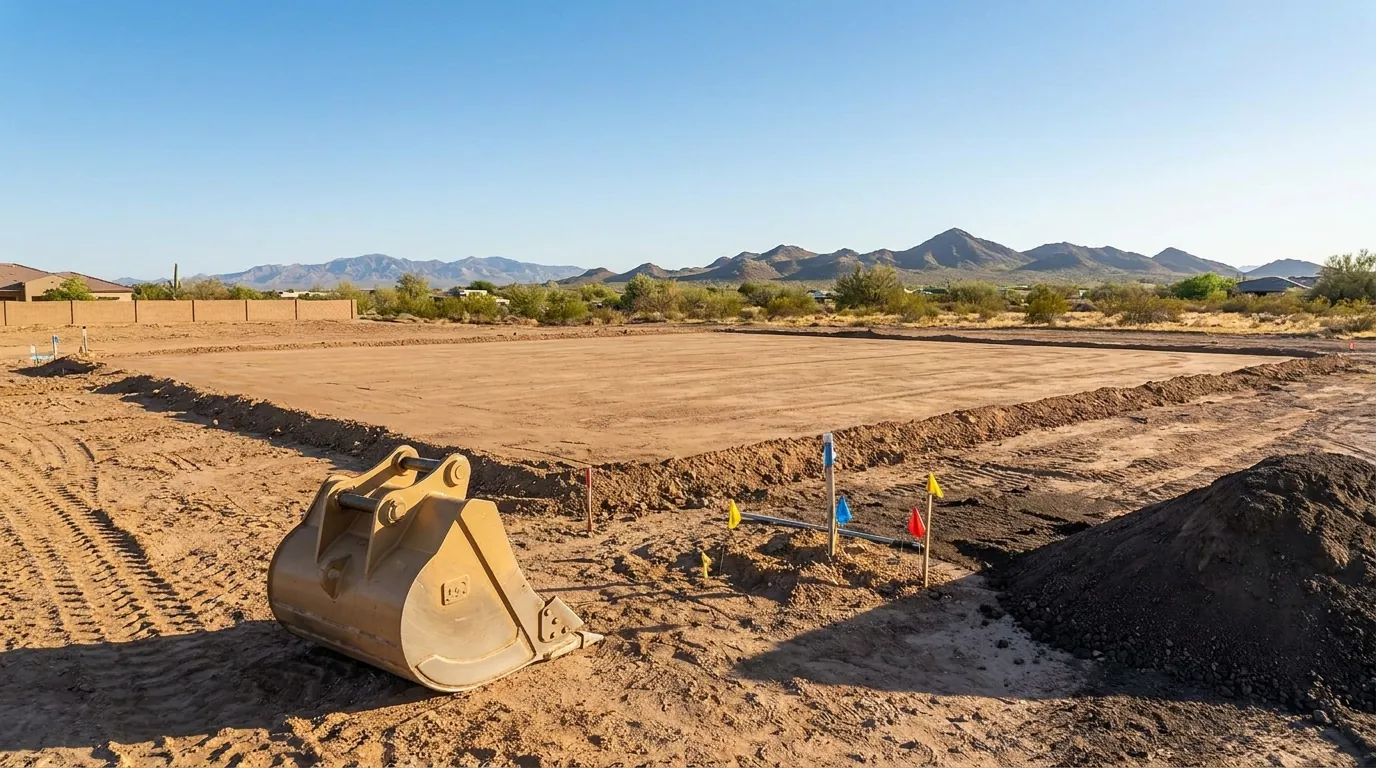
What grading does and why it matters here
Grading is the work of reshaping the surface of a lot so that it drains, supports weight, and sits at the right elevation for whatever gets built on it. In Gilbert, the two forces that make grading essential are the same two that make it hard: caliche soils that shed water instead of absorbing it, and monsoon storms that dump an inch or more of rain in an afternoon. A lot that looks flat to the eye can still slope back toward a house by a fraction of an inch per foot — enough to pond water against a slab every July and August.
A grading contractor sets the finished surface to a plan: positive slope away from structures, controlled low points that carry runoff to the street or a retention area, and a compacted base that will not settle unevenly under a driveway, patio, or foundation. Getting this right at the start is far cheaper than fixing a wet slab or a sinking pad later. If you are also planning to build, our foundation excavation crew works from the same site plan so the pad and the surrounding grade tie together.
How a grading job runs
Every lot is different, but most grading projects in the Gilbert area follow the same sequence.
-
Survey the existing surface
We read the lot's current elevations, find the natural drainage path, and compare it to where water actually needs to go — usually a street, alley, or approved retention basin. This is where we spot the low spots that trap monsoon runoff.
-
Strip and stockpile
Topsoil, old vegetation, and any loose fill get removed and set aside. On many Gilbert lots the next layer down is caliche, a hard cemented soil that behaves very differently from ordinary dirt when you cut into it.
-
Cut, fill, and shape
We move material from high areas to low ones to build the slope the plan calls for, typically a fall of at least a quarter inch per foot away from any structure for the first several feet.
-
Compact in lifts
Fill is placed and compacted in layers rather than all at once, so it will not settle after the first heavy rain. Caliche and desert soils each need their own moisture and compaction approach to hold.
-
Fine grade and check
A final pass smooths the surface and we re-check elevations against the plan before anything is built or paved on top.
Local conditions change the plan
Caliche is the defining factor for grading in Gilbert and the surrounding towns. Because it is nearly impermeable, water that reaches it stops and spreads sideways instead of soaking in. That means a lot has to be shaped to carry water off the surface — you cannot count on the ground to drink it. Where caliche sits close to the surface, cutting to grade may require ripping or breaking rather than simple scraping, which affects equipment and time.
Monsoon season, roughly July through September, is the real test of any grade. A surface that drains well in dry weather can still fail under a sudden downpour if the low points and outfalls were not sized for it. We plan slopes and flow paths for those storm volumes, not for an average day. Where surface grading alone is not enough, a project may also need drainage excavation to move water underground. For a fuller look at how grade protects a house, our article on site grading and foundations walks through the connection.
Whether you have a new build, a re-grade to solve standing water, or a site being prepped for paving, the first step is a look at the lot. Call to talk through your grading project in Gilbert and the surrounding area.
Frequently asked questions
How much slope does a graded lot need in Gilbert?
A common target is a fall of about a quarter inch per foot away from structures for the first several feet, then a controlled path to the street or a retention area. The exact numbers depend on your lot size, the finished elevations, and where water is allowed to leave the property.
Why does caliche matter for grading?
Caliche is a hard, cemented desert soil that does not absorb water well, so runoff has to be carried off the surface rather than left to soak in. It can also be tough to cut, which affects how a grade is built and what equipment the job needs.
Will grading stop water from pooling near my house?
Regrading to create positive slope away from the structure is the most common fix for pooling against a slab. In some cases surface grading is paired with drainage excavation to handle heavy monsoon flow that grading alone cannot move fast enough.
Can you grade a lot before I build?
Yes. Grading a lot to plan elevations is standard site work before a foundation goes in, and we can coordinate the pad and surrounding grade so they tie together correctly.
Talk to someone about your job
Call to describe the problem and get a quote for work in Gilbert, AZ.