Gravel Driveway Installation in Gilbert, AZ
Gravel driveway installation in Gilbert, AZ. We build compacted, well-drained gravel drives and access roads that hold up to heat and monsoon runoff.
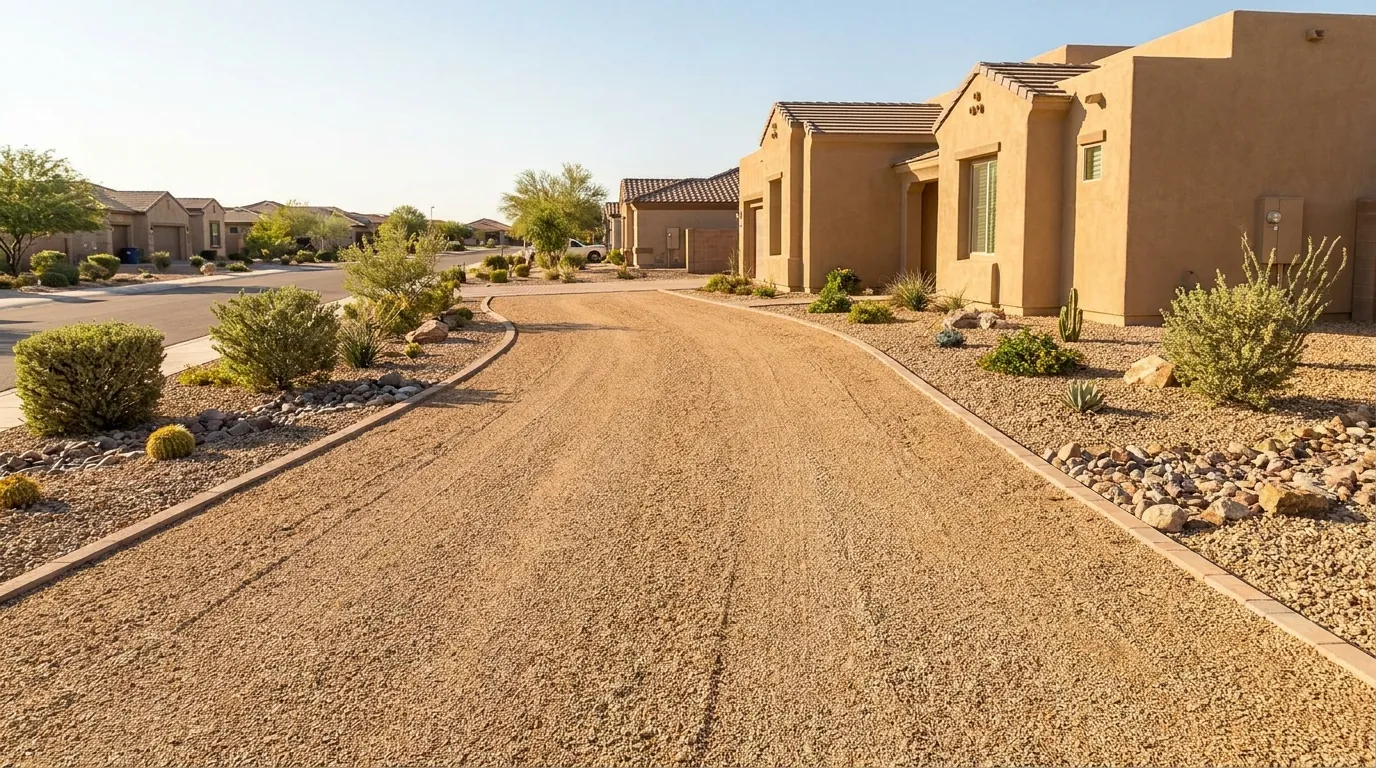
A driveway that lasts starts underneath
A gravel driveway looks simple, and a good one is — but the difference between a drive that stays firm for years and one that ruts, washes, and turns to washboard after every storm is entirely in the base beneath the stone you see. Gravel driveway installation is really earthwork: stripping the soft surface, building and compacting a base, shaping the surface to drain, and only then placing the gravel. On Gilbert-area lots, where the ground is caliche and the rain comes hard and fast, that base work is what separates a driveway from a rut.
Homeowners choose gravel for a new build's access, a longer rural drive in Queen Creek or San Tan Valley, a parking area for equipment, or a repair of a drive that has already broken down. Whatever the reason, the installation follows the same logic as our other site work: shape the ground, control the water, compact the material, and check the result.
How we build a gravel drive
Each step protects the one above it.
-
Strip and shape the subgrade
We remove vegetation and loose surface soil, then shape the subgrade with a slight crown or cross-slope so water runs off rather than sitting in the drive.
-
Compact the base
The subgrade is compacted, and where the soil is weak a base layer of larger aggregate is added and compacted to spread vehicle loads.
-
Place the surface gravel
A wearing course of appropriately sized gravel goes on top, graded to the shape that keeps the driveway shedding water.
-
Compact and finish
The surface is compacted so the stone locks together instead of scattering under tires, giving a firm, drivable finish.
Heat, caliche, and monsoon washouts
The enemy of a gravel driveway in Gilbert is moving water. A monsoon downpour can carve a channel down a flat, poorly drained drive in a single storm, carrying the gravel with it. That is why we build a crown or cross-slope into every drive and, on longer runs, add cross-drainage so storm water crosses rather than runs down the length of the driveway. Where a drive sits in a low area, we may pair it with drainage excavation so runoff has a controlled path away from the surface.
Caliche affects the build too. As a hard, stable layer it can make a good foundation for a drive, but its resistance to digging changes how the subgrade is prepared, and its poor absorption means every drop of rain stays on the surface until you route it off. Dry heat, meanwhile, is easy on gravel itself — it is the storms, not the sun, that do the damage. A well-crowned, well-compacted drive built for those storms will hold its shape with only occasional regrading. Call to talk through a new gravel driveway or a repair anywhere around Gilbert.
Frequently asked questions
Why does my gravel driveway keep washing out?
Almost always because water runs down the length of the drive instead of across and off it. Building a crown or cross-slope and adding cross-drainage where needed keeps monsoon runoff from carving channels and carrying the gravel away.
Do I really need a base, or can you just spread gravel?
A compacted base is what makes a gravel drive last. Gravel spread over soft or unshaped soil ruts and spreads under traffic, while a shaped, compacted base spreads vehicle loads and holds the surface in place.
Does caliche help or hurt a gravel driveway?
Both. As a hard layer caliche can provide a stable foundation, but it resists digging and does not absorb water, so the drive must be shaped to shed every bit of rain off the surface.
How much maintenance does a gravel drive need?
A properly crowned and compacted drive built for local storms needs only occasional regrading to keep its shape. Most problems come from drives that were never shaped to drain in the first place.
Talk to someone about your job
Call to describe the problem and get a quote for work in Gilbert, AZ.